

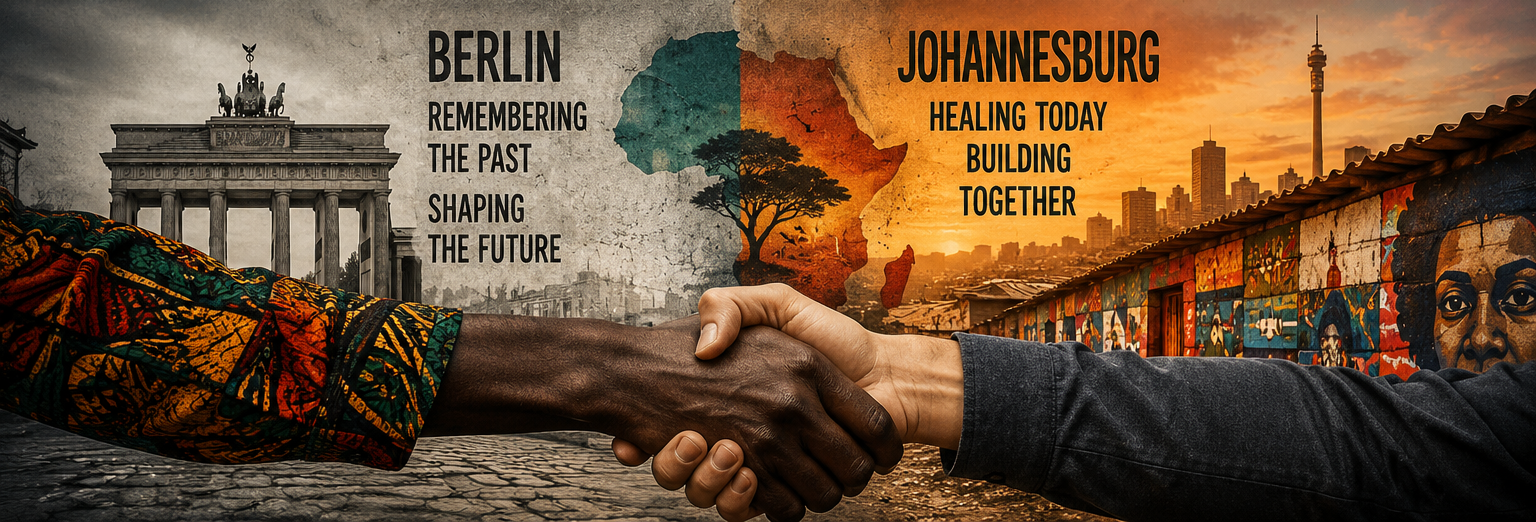
By Kelechi Eze Esq. – EuroAfrica News Magazine Feature Writer Berlin and Johannesburg are two cities deeply shaped by racial history. One became the symbol of Nazi racial ideology and the horrors of the Holocaust. The other emerged from the painful legacy of Apartheid and became known worldwide as the “Rainbow Nation.” Yet today, both cities continue to raise urgent questions about race, identity, memory, and human dignity.
While Germany has spent decades confronting its past through education, memorialisation, and institutional accountability, South Africa faces growing criticism over repeated violence against fellow Africans. These attacks are often described simply as xenophobia. However, many scholars and activists argue that the term Afrophobia more accurately explains the reality unfolding in parts of South Africa today.
Afrophobia refers to prejudice, hostility, discrimination, or violence directed specifically at people of African descent and Blackness itself. Unlike general xenophobia, which targets foreigners broadly, Afrophobia is selective. It often affects Black African migrants while Europeans, Asians, or white foreigners may face far less hostility.
This distinction matters greatly because it forces societies to confront deeper historical and psychological wounds connected to colonialism, slavery, racial hierarchy, and economic inequality.
Understanding Afrophobia Beyond Xenophobia
The word xenophobia suggests fear or hatred of foreigners. Yet the violence repeatedly witnessed in South African townships tells a more complicated story. Nigerians, Zimbabweans, Somalis, Ethiopians, Malawians, and other African migrants have frequently become the main targets of attacks, looting, discrimination, and social exclusion.
This pattern raises difficult but necessary questions.
Why are fellow Africans disproportionately targeted? Why are African-owned shops burned while businesses owned by non-African foreigners often remain untouched? Why does frustration over unemployment, poverty, crime, or weak public services become directed mainly at Black African migrants?
Afrophobia is rooted in long-standing global systems that associated Blackness with inferiority, criminality, and social exclusion. Colonial structures deliberately divided African communities, weakened continental unity, and normalised racial hierarchies that still influence attitudes today.
Its effects appear in several forms:
- Discrimination in employment and housing
- Unequal legal protection
- Stereotyping Africans as criminals or economic threats
- Dehumanisation of migrants
- Social exclusion and political scapegoating
Even within Africa itself, darker-skinned Africans or migrants from poorer African countries are often treated as outsiders. This painful contradiction reveals how deeply colonial mentalities can survive long after political independence.
South Africa’s Historical Irony
Perhaps the greatest tragedy lies in the fact that many African nations sacrificed enormously to support South Africa’s liberation struggle during Apartheid.
Nigeria, in particular, played a major role in financing and supporting anti-Apartheid movements. Under leaders such as Olusegun Obasanjo, Nigeria provided financial assistance to the African National Congress (ANC), funded scholarships for South African students, and pushed aggressively for international sanctions and sports boycotts against the Apartheid regime.
Ordinary Nigerians also contributed through the South Africa Relief Fund, often described as support paid with the “oil and sweat” of the Nigerian people. Thousands of South Africans benefited from educational opportunities abroad because their own government denied them equal education under Apartheid policies.
Across Africa, countries such as Zambia, Tanzania, Angola, and Mozambique became frontline supporters of liberation movements despite facing economic hardship and military pressure themselves.
Today, however, many African migrants living in South Africa feel abandoned, unwelcome, or even hunted. This creates a painful contradiction between the ideals of Pan-African solidarity that once united the continent and the reality now experienced on the streets of Johannesburg, Durban, and other cities.
Economic frustrations undoubtedly contribute to the crisis. South Africa continues to battle severe unemployment, inequality, crime, and social instability. Yet economic hardship alone does not fully explain why the anger is so often directed specifically at fellow Africans.
When a Nigerian entrepreneur is attacked while a European tourist is warmly welcomed, the issue moves beyond ordinary xenophobia into something deeper and more troubling.
What Johannesburg Can Learn from Berlin
Berlin’s transformation after World War II did not happen automatically. Germany was forced to confront the consequences of hatred, racism, propaganda, and systemic dehumanisation.
One important concept in modern German society is Vergangenheitsbewältigung — the struggle to come to terms with the past. Germany invested heavily in remembrance culture, historical education, memorials, museums, and public accountability.
Throughout Berlin, memorials such as the Stolpersteine (“Stumbling Stones”) remind citizens daily about the victims of Nazi persecution. Schools openly teach the crimes of the Nazi era, ensuring future generations understand the dangers of racism and extremist ideology. South Africa can draw valuable lessons from this approach.
1. Education Must Preserve Historical Memory
Many young Africans today know very little about the continental struggle against Apartheid. Schools and public institutions should teach the role played by African nations in supporting South Africa’s liberation.
Young South Africans should understand that their freedom was not achieved alone. It was supported by sacrifices made across the continent.
2. Political Leaders Must Avoid Dangerous Rhetoric
Blaming migrants for economic hardship may provide short-term political gains, but it fuels division and violence. Political leaders, media platforms, and public figures must avoid language that scapegoats African migrants for structural economic problems.
Berlin’s postwar transformation required strict opposition to hate speech and racial incitement. South Africa must equally reject narratives that normalise hostility toward fellow Africans.
3. The African Diaspora Must Speak Out
Africans living abroad also have a responsibility to encourage unity, dialogue, and accountability. Pan-African media, intellectual networks, and civil society groups can help preserve historical truth while challenging divisive narratives.
Platforms such as EuroAfrica Media Network and EuroAfrica News Magazine help amplify voices calling for intercultural understanding, historical awareness, and African solidarity.
Reclaiming the Rainbow Nation
South Africa’s liberation represented one of the greatest victories for human dignity in modern African history. It inspired millions across the world because it symbolised justice, reconciliation, and hope. Yet the continued violence against African migrants threatens that legacy.
Johannesburg now stands at an important crossroads much like Berlin once did. It can either continue denying uncomfortable realities or courageously confront the roots of Afrophobia through education, leadership, and collective reflection.
Pan-Africanism was never simply a political slogan. It was built on shared sacrifice, shared suffering, and shared dreams of dignity for all Africans. Forgetting that history is not merely an act of ingratitude. It risks weakening the very spirit of unity that helped defeat colonialism and Apartheid in the first place.
If Africa is to build a stronger future, Blackness must be celebrated rather than feared. Fellow Africans must be seen not as enemies, but as partners in a common continental destiny.