

By Kelechi Eze Esq. – EuroAfrica News Magazine Feature Writer
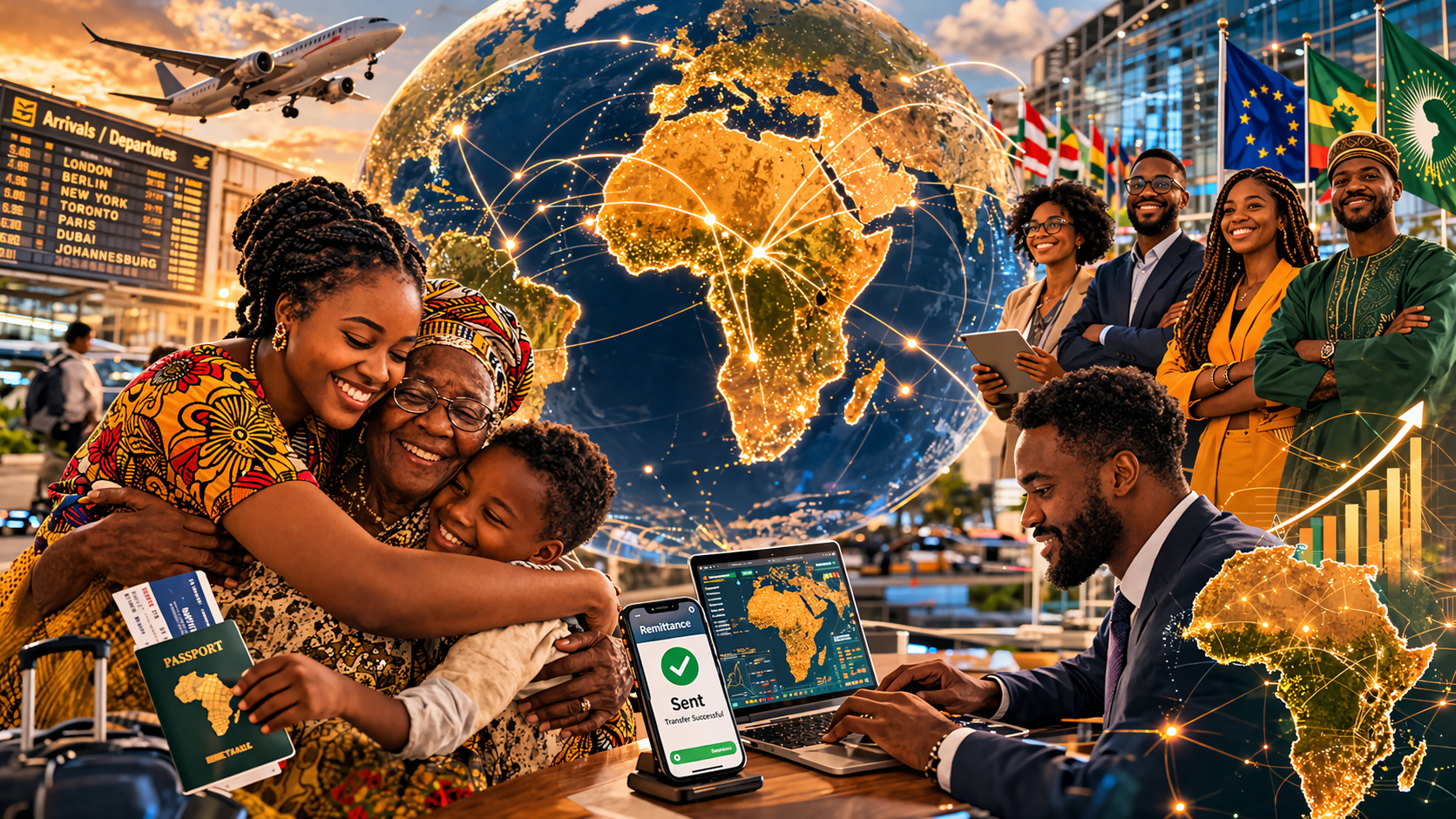
For decades, discussions about Africa’s development have focused on governments, institutions, and foreign partners. Yet one of the continent’s most powerful actors operates largely outside formal systems: its diaspora. With over 40 million Africans living abroad, according to the United Nations, this globally dispersed community is far more than a source of remittances. It represents a dynamic force shaping economic stability, political engagement, and global perceptions of Africa.
What is often underestimated is this: Africa’s diaspora is not just supportive—it is strategic.
Beyond Remittances: A Pillar of Economic Stability
The most visible contribution of the diaspora is financial. Across Sub-Saharan Africa, remittances amount to tens of billions of dollars annually, with countries like Nigeria consistently ranking among the largest recipients.
In many cases, these inflows:
- Exceed foreign direct investment
- Rival or surpass development aid
- Stabilise households during economic downturns
Unlike volatile capital flows, remittances provide a reliable financial lifeline. They sustain families, fund education, support healthcare, and drive local consumption.
However, their long-term development potential remains underutilised. Structural challenges—such as weak financial systems, high transfer costs, and policy uncertainty—limit their transformation into large-scale investment.
There is also a paradox: by cushioning economic hardship, remittances can reduce pressure on governments to deliver reforms, unintentionally weakening accountability.
Political Influence Without Borders
The African diaspora is increasingly becoming a political actor—despite limited formal representation in many countries. Through digital platforms, funding networks, and advocacy campaigns, diaspora communities are shaping political discourse from abroad. A striking example is Nigeria’s 2023 elections and the global mobilisation behind the candidacy of Peter Obi. Diaspora networks across the United States, United Kingdom, and Canada played a significant role in:
- Digital campaigning
- Voter mobilisation support
- Fundraising initiatives
Movements amplified through platforms like X (formerly Twitter) and TikTok demonstrated how influence today extends beyond physical borders.
This form of transnational engagement shows a new reality: political participation is no longer confined to geography.
Soft Power: Redefining Africa’s Global Image
Perhaps the most transformative impact of the diaspora lies in shaping how Africa is seen globally.
Through literature, media, film, and cultural production, diaspora voices are redefining narratives about the continent.
Writers such as Chimamanda Ngozi Adichie have challenged one-dimensional portrayals of Africa, presenting more nuanced perspectives on identity, migration, and society.
Media platforms, including those led by figures like Chris Ifeanyi Ezeh, are actively bridging Africa–Europe narratives, highlighting stories that counter stereotypes and promote intercultural understanding. In film and storytelling, creators such as Adamma Ebo and Adanne Ebo contribute to a growing global presence of African narratives. This cultural influence is not merely symbolic—it carries economic and geopolitical weight. Perception shapes investment, partnerships, and policy decisions.
The Structural Challenge: Fragmentation and Missed Potential
Despite its growing influence, the African diaspora faces significant limitations.
Key challenges include:
- High remittance transfer costs
- Weak institutional frameworks
- Policy inconsistency
- Limited political inclusion
More fundamentally, the diaspora lacks a unified and coordinated voice.
Unlike other global diaspora groups that exert strong collective influence, African diaspora communities often operate in fragmented networks—divided by nationality, language, and political interests.
This fragmentation reduces their ability to:
- Influence global policy
- Advocate effectively for African interests
- Mobilise at scale
Without stronger coordination, a powerful asset remains underleveraged.
From Passive Resource to Strategic Asset
To unlock the full potential of Africa’s diaspora, a shift in approach is required—from passive reliance to active integration.
Key Strategic Priorities
1. Channel Remittances into Investment
Diaspora bonds and structured investment platforms can convert financial flows into infrastructure, business growth, and job creation.
2. Reduce Transaction Costs
Financial reforms and digital solutions can significantly increase the value of remittances reaching local economies.
3. Expand Political Inclusion
Voting rights and institutional participation can strengthen accountability and engagement.
4. Build Coordinated Diaspora Frameworks
Governments must create structured platforms for diaspora engagement at national and continental levels.
5. Integrate Diaspora into Development Strategy
The diaspora should be treated as a core pillar of Africa’s global positioning—not as an external add-on.
Emerging Models: A Glimpse of What Works
Some African countries are already taking steps in this direction.
- In Nigeria, diaspora bonds have attracted strong investor interest and supported infrastructure financing.
- Ghana has launched investment forums and institutional platforms to engage its diaspora more effectively.
- Kenya is implementing a national diaspora investment strategy, linking remittances to long-term development goals.
These examples demonstrate that structured engagement is possible—and scalable.
Conclusion: Africa’s Most Underrated Global Advantage
Africa’s diaspora is far more than a financial contributor. It is a transnational force operating at the intersection of economics, politics, and identity.
In a world where influence increasingly flows through networks rather than borders, the diaspora represents one of Africa’s most powerful strategic assets.
The real challenge is no longer whether the diaspora can contribute—it already does.
The question is whether African governments and institutions are ready to harness this power effectively.
The answer will shape Africa’s future role in the global order.
#AfricanDiaspora #DiasporaPower #AfricaRising #GlobalAfrica #Remittances #EconomicImpact #SoftPower #AfricaEurope #DiasporaInfluence #MigrationAndDevelopment #AfricanVoices #GlobalNetworks #AfricaEconomy #PolicyMatters #DiasporaEngagement #AfricaStrategy #InternationalDevelopment #EuroAfrica #AfricaFuture #GlobalInfluence